The commute is up to about an hour again, enough for trains of thought to develop. There are options now: regional train or S-Bahn. You need to change once in any case. That’s new.
What exactly is an S-Bahn, Stadt-Schnellbahn? The atmosphere is different to the atmosphere among commuters on a Class 365, or on its successor, the 387. These felt like real trains. The Class 700 was a step towards a connected metro feeling: connected carriages, harder seats, more like the S-Bahn, especially when on a stopping service, but with toilets.
On a commuter train to London everyone is, by definition, aiming for the same place. The S-Bahn is a cross between the London commuter train and the underground. You don’t know where people will be getting on or off, you don’t develop that sense of common purpose that you get after forty minutes of sitting or standing together.
In November before the move, when the commute was only about ten minutes long, I observed three young rascals sitting on the floor in the bike storage section watching rap videos on their phones. Staccato speech. One of them nudges the girl in the middle who exclaims: “ich dachte mich hätte jemand bombardiert” (felt like someone just bombed me), then, more self-consciously “ich hab mich hier hingelegt wie Zuhause” (I’m lying here like at home), followed by “totally comfortable,” then “digger, what the f***” while looking at a video… I took out my phone and began drafting these notes, inspired by their rough familiarity…
These 10-year old girls, so natural in this moving public space: unabashed, friendship, companionship, technology… digital urchins… they remark again how comfortable they feel: “soll ich die Matratze bringen…” (shall I bring a mattress) one of them asks… they help each other with the games they are playing and comment on videos.
Now, after the move, on an S-Bahn for longer, noticing people again…
What makes me start thumbing fragments into my phone? “Trains of thought” as an antidote to “AI.” Perhaps that’s it. A fear of losing natural connection. Co-pilot has arrived at work… and of course it is gaining in use.
A question of style arises: do you let it be obvious that you’re using this tool? The question of how to use and integrate this unnatural helper is more complicated the more you think about it.
AI is for others, for work, art is for yourself. Perhaps that’s the formula then.
What do we see, say on a Thursday morning? A boy with a white synthetic jacket and “7Heavens” jogging pants, he’s 13 perhaps, and he’s moving from Whatsapp chats to Instagram then Gmail… And next to him a girl knitting, pushing thread into her knitting needle, or pulling it out to gain material for her work? Then large man joins the seating group, pushing his way to the window seat while watching TikTok videos with noise cancelling headphones. The TikTok is full of female, made-up faces among other content. The videos have subtitles, I catch a glimpse of a clip: “would you date a guy who…” Puzzled, pouting face…
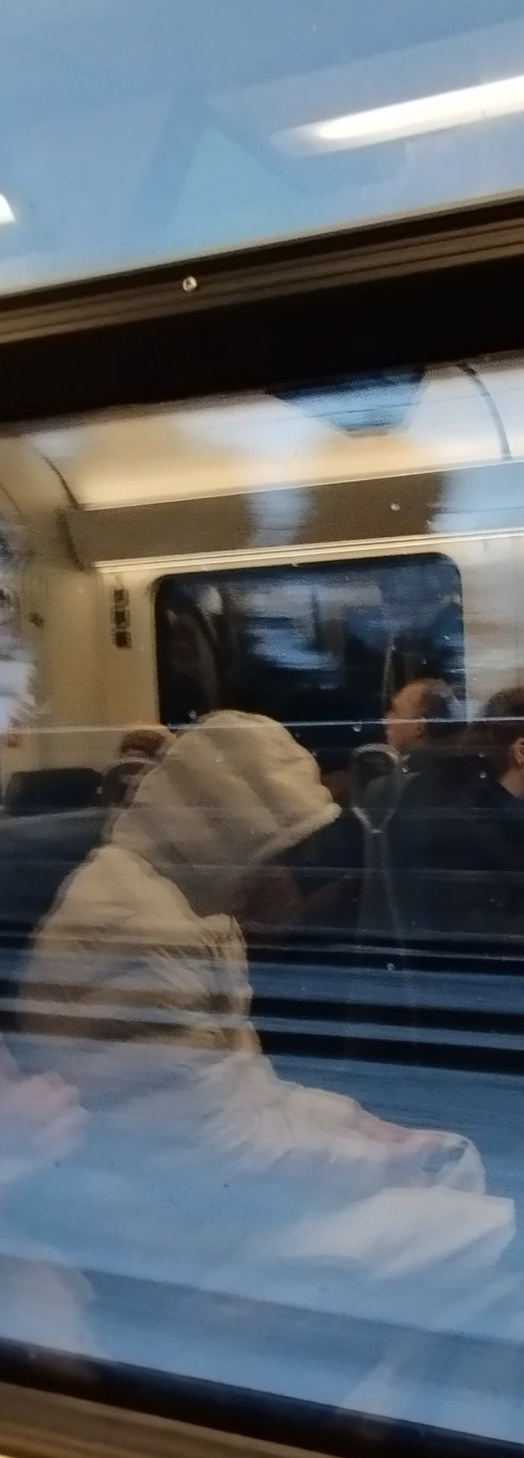
When he takes his hood off the boy’s hair extends to a fringe over his forehead. He nurses the fringe. The haircut is recent, the sides are still sharp. We’re at Balham now, reminding me of Baldock years ago. He gets off. There must be a school here. In his place now a middle-aged woman who looks like she’s stepped out of the large man’s TikTok video: red fingernails, black hair coloured blonde, an international style, or the German version of an international style. Suntanned, iPods, frowning at the floor.
It’s a relief to be writing this again. No expectation, no goal, just a bit of attention and the transmission of thoughts into a few words, and then the interaction between thoughts and typed words.
On the the S-Bahn information screen a duck and an elephant are playing golf. And then it’s my turn to get off.
 notes and attempts